









Profile view of a bearded man wearing a black baseball cap and a dark gray T-shirt against a plain light background.

How cold is too cold for a heat pump in South Dakota

Step 1 of 3: Equipment

Most heat pumps lose their edge once outdoor air drops into the single digits, and in a South Dakota winter that happens for weeks at a stretch. Below about 5 degrees Fahrenheit, the outdoor unit struggles to pull enough heat from the air to keep up with the house, and the system leans harder on backup heat to make up the difference. This isn't a sign anything is broken. It's how the refrigerant cycle works: colder air just has less heat in it to move indoors. Older heat pumps tend to give up sooner, sometimes around 20 to 25 degrees, while newer cold-climate models can keep working well below zero. If your heat pump is the main source of heat for the house, a hard South Dakota cold snap is exactly when you'll notice it falling behind, and that's worth planning for before the next one hits rather than during it.

A gray-haired bearded man in a dark coat and scarf dusted with snow stands smiling in a dimly lit entryway with a white front door, a side table with a lit lamp, an oval mirror, and a patterned rug.
An older bearded man in a dark snow-dusted coat and gray scarf stands just inside a dimly lit home entry, with a framed picture, lit table lamp, and an adjoining room with a fireplace behind him, and snow visible through the open door.
A gray-haired, bearded man in a dark snow-dusted coat stands smiling in a dimly lit entry hall with a staircase, a lit table lamp, a framed picture, and a living room visible through a doorway.
An older man with gray hair and a beard, wearing a dark jacket dusted with snow, stands smiling in a dimly lit hallway with lamps and a living room visible behind him.

A heat pump doesn't make heat, it moves it. It pulls warmth out of the outdoor air and pushes it inside, and that gets harder as the air gets colder because there's less heat out there to grab. Frost builds up on the outdoor coil as it works, so the system runs a defrost cycle every so often, switching briefly into cooling mode to melt that frost off before going back to heating. Seeing ice on the unit in winter is normal. Once the outdoor temperature drops to somewhere around 25 to 30 degrees, the compressor hits its limit and can't pull in enough heat on its own to match what the thermostat is asking for. That point is called the balance point, and below it, a backup heat source has to carry part of the load. Most installs in South Dakota pair the heat pump with a gas furnace for exactly this reason, since gas is already how most homes here heat, and the furnace is what takes over when the outdoor air gets too cold for the heat pump to keep up alone.

Why heat pumps slow down in the cold

  • A heat pump moves heat from outside air into your house, so the colder that air gets, the less heat it has to move.
  • Most outdoor units have a defrost cycle that melts frost off the coil, and it briefly runs the system backward like an AC to do it.
  • Below a set outdoor temperature, usually around 25 to 30 degrees, the compressor can't pull enough heat to meet the thermostat on its own.
  • A balance point is the outdoor temperature where a backup heat source has to kick in alongside the heat pump to keep the house warm.
  • Most installs here pair the heat pump with a gas furnace as backup, since that's how most South Dakota homes already heat.
  • The outdoor unit still has refrigerant lines and a compressor exposed to the weather, so ice buildup on the coil is normal in winter, not a sign of failure.
A gray outdoor heat pump unit on a concrete pad beside a house with horizontal lap siding, with a conduit running to a wall-mounted disconnect box and a green shrub to the left.
Clean coil, clear airflow, the unit keeps up with a South Dakota cold snap on its own.
An outdoor air conditioning condenser unit with dusty coils sits on a concrete pad against light horizontal siding, with an electrical disconnect box and refrigerant lines on the wall and a shrub and mulch at left.
Dirt and neglect catch up to a heat pump fastest on the coldest days, when it has the least heat to spare.
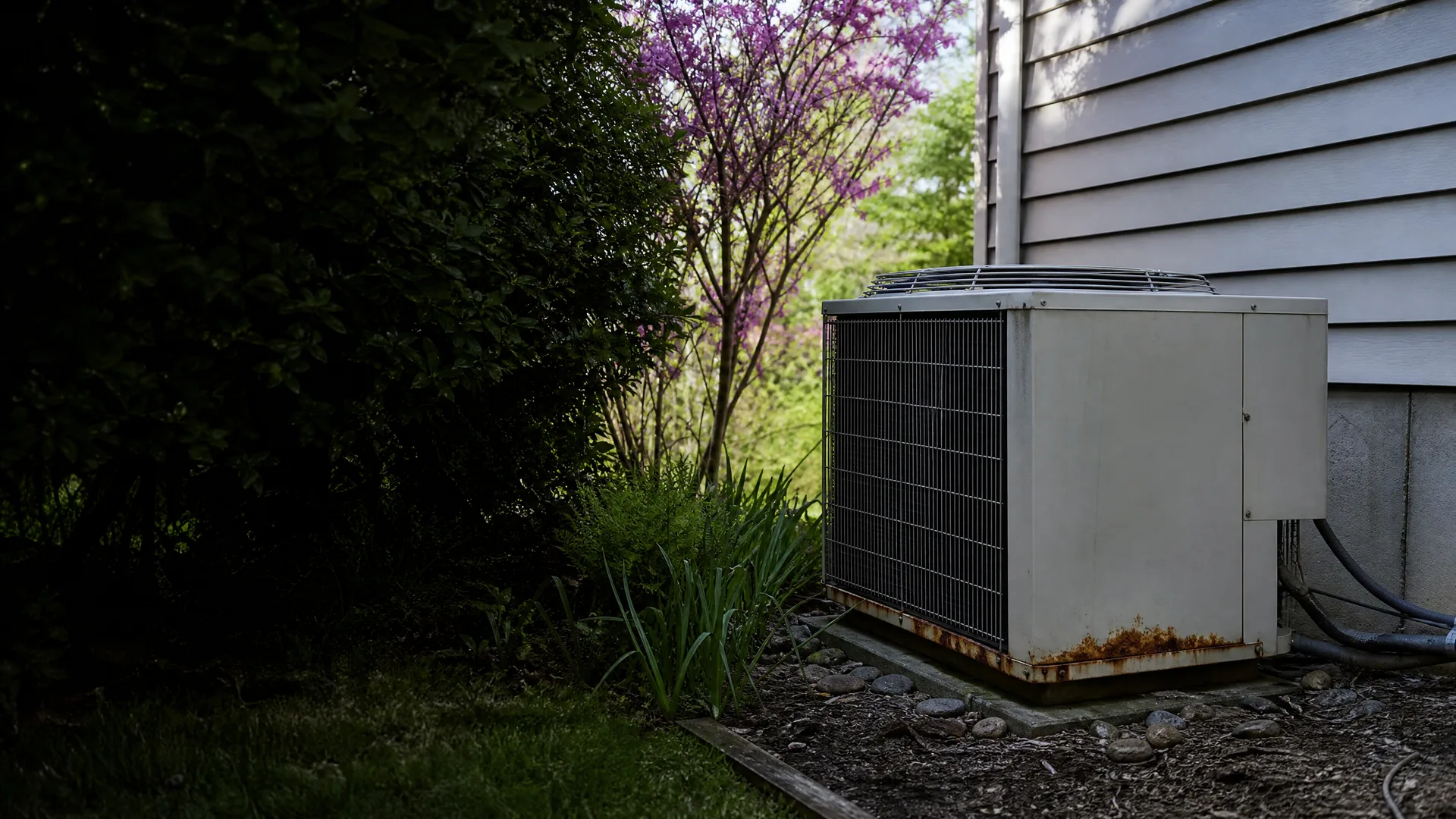
An outdoor air conditioning condenser unit with rust streaks sits on a concrete pad beside a light-colored lap-sided house, surrounded by shrubs, gravel and a flowering tree.

You walk out to the side yard in March, snow mostly gone, mud still soft underfoot. The outdoor unit has been running hard all winter and it shows. Rust climbs the base where water from the defrost cycle has dripped and sat all season. The fan spins but sounds rougher than it did in November. You crouch down and see the coil fins are bent in a few spots, caked with yard debris that never got cleared before the cold set in. You've kept this house up for years, and you know a unit working this hard, this rusted, won't make it through another South Dakota winter without help. You've already decided you don't want to spend your weekend calling around to find out who can look at it.

The right pro for this job

Skip the round of in-home estimates for a new heat pump.

No charge to send it. You decide if you hire them.

What backs up the heat on cold days

Most heat pumps installed in South Dakota come with a backup heat source built into the same system, usually electric resistance coils or a connection to a gas furnace, since most homes here heat with gas. When the outdoor unit can't keep up on the coldest nights, the backup kicks in automatically to cover the difference. You don't notice the switch from inside the house. The thermostat is still calling for the same temperature, and the system decides how to get there. This is standard equipment, not an add-on, and it's why a heat pump works as a year-round system here rather than something that gets shut off every November.

Sizing it right matters more here

A heat pump sized for a mild climate struggles in a South Dakota winter, and one sized too big for the house wastes money on every mild day in between. The sizing has to account for how much heat the house loses on the coldest days of the year, not just the square footage. Get this wrong and the backup heat runs more than it should, which shows up on the power bill even though power here is cheap. An installer who works in this climate knows to size around the local design temperature rather than a national average, and that number is different here than it is two states over.

An outdoor air conditioning condenser unit on a concrete pad beside a house with horizontal lap siding, with a green shrub to the left and a wide concrete slab in the foreground.
Before you get your heat pump installation
A gray outdoor condenser unit on a concrete pad beside a house with horizontal lap siding, with a wall-mounted disconnect box, conduit and insulated refrigerant lines, a shrub at left and gravel at right.
After you get your heat pump installation

Running the heat pump alone

Some homeowners set the system to rely on the heat pump down to its limit before backup kicks in. It keeps the electric coils or the furnace quiet more of the time, and power here is cheap enough that the savings from doing this are modest. The tradeoff shows up on the coldest nights, the ones well below zero, when the house can lag a degree or two behind the thermostat setting while the unit works to keep up. For a lot of South Dakota winters, that lag is the only cost.


Letting backup take over early

Other homeowners set the backup heat to engage sooner, before the heat pump is straining. Since most homes here already heat with gas, the furnace picking up the load on a hard cold snap is not asking much of the system. The house holds its temperature more evenly and the outdoor unit isn't working at its limit through the worst stretches of January. The difference costs a little more to run that way, though with cheap power locally it tends to be small.

Power costs 13.32 cents per kilowatt-hour statewide

At 13.32 cents a kilowatt-hour, running the backup heat strip on your heat pump through a cold snap won't wreck your bill the way it might in a state with pricier power. That gives you more room to let the heat pump work before backup has to help it along.

EIA-861 2025 statewide residential average

Where your heat pump stands in the cold

  • A heat pump in South Dakota starts losing real heating power once outdoor air drops into the single digits.
  • Below about 5 degrees Fahrenheit, backup heat has to take over most of the work of keeping your house warm.
  • The backup coils or furnace tied to your system exist for exactly these cold snaps, not as a sign anything is wrong.
  • A clean coil and clear airflow are what let a heat pump keep up as long as it can before backup has to step in.
  • Finding a contractor who installs and sets up that backup correctly for a South Dakota winter is the part worth not doing alone.
  • Skipping the calls, the comparisons and repeating your situation to five different companies leaves more room to get the setup itself right.

Your heat pump works fine through most of a South Dakota winter. It starts to lose ground once outdoor air drops into the single digits, and by about 5 degrees it needs backup heat to carry most of the load. That's not a fault. The electric coils or furnace wired into your system are there for those exact weeks, so the house stays warm when the outdoor unit can't pull enough heat from the air on its own. A clean coil and clear airflow buy the heat pump more time before backup has to step in, but they don't change the point where physics takes over.

Knowing that number doesn't tell you whether your system is set up to handle it. Some units are installed with a backup that kicks in too late, or too early, or isn't sized right for how cold it gets where you live. Figuring that out means calling around, explaining your setup to each contractor, and sorting through quotes that are hard to compare because nobody's looking at the same thing. Getting matched with a contractor who already knows how a South Dakota winter treats a heat pump skips that part. You still have a decision to make about your system. You just make it with someone who's seen this cold snap before, instead of working through it on your own.

A wooden front door with six small glass panes and a narrow sidelight, set in a shingled house entry with white trim, reached by stone steps flanked by a planted urn with purple flowers and leafy branches in the foreground.
Exterior corner of a house with beige horizontal lap siding and a black-framed window, with white hydrangeas, ornamental grasses and low plantings along a flagstone patio.
Corner of a house with tan lap siding and a window, a brick step edge, flowering white hydrangeas and green shrubs beside a flagstone walkway leading to a white picket fence and a tree in backlit sunlight.
House exterior with cream horizontal lap siding, a dark-framed window, a black wall lantern beside a wood door, potted shrubs on stone steps, and white and pink hydrangeas in the foreground garden.
Corner of a cream lap-sided house with a white-framed window and dark shingled roof, beside a white-flowering hydrangea shrub, a clipped hedge, mulched bed and lawn.

Matched to your heat pump job

Describe the project once instead of to every installer.

Connect with a pro

There's no charge for the request.


